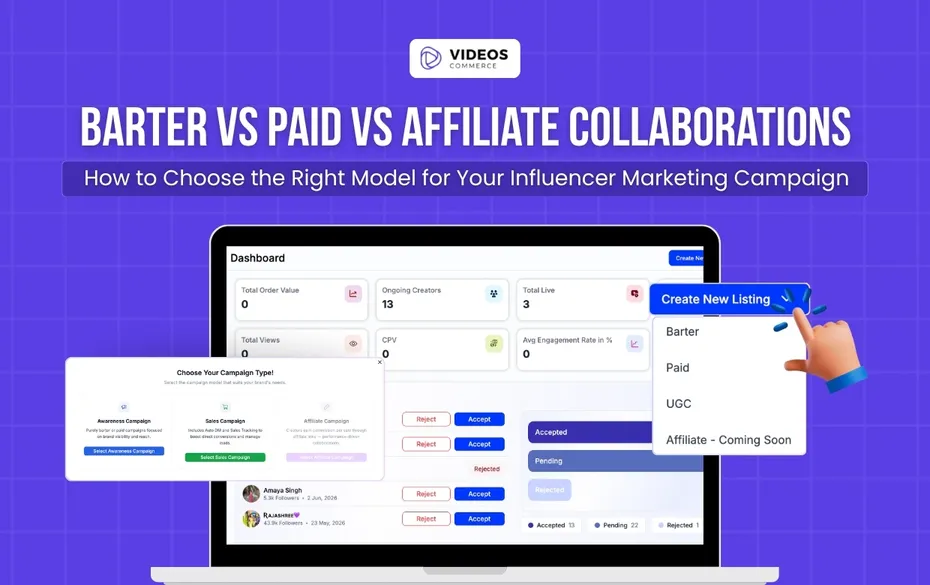
Every brand running influencer campaigns eventually asks the same question: should creators be paid in product, in cash, or in commission? The answer changes depending on what you're trying to achieve.
Barter, paid, and affiliate collaborations are the three foundational compensation models in influencer marketing, and each one serves a different purpose. Barter works well for product seeding and organic content at scale. Paid collaborations work well when you need guaranteed reach and creative control. Affiliate partnerships work well when the goal is measurable, sales-driven performance.
There is no universally "best" model. A skincare brand launching a new product, a fashion label building brand awareness, and a D2C startup chasing conversions will each reach for a different collaboration structure — sometimes all three at once.
This guide breaks down how barter, paid, and affiliate collaborations actually work, where each one delivers the strongest return, and how to decide which model (or combination of models) fits your next campaign. By the end, you'll have a clear framework for matching your collaboration model to your budget, your creator type, and your campaign goal.
- What Are Influencer Collaboration Models?
- What Is a Barter Collaboration?
- What Is a Paid Collaboration?
- What Is an Affiliate Collaboration?
- Barter vs Paid vs Affiliate Collaborations: A Side-by-Side Comparison
- Choosing the Right Collaboration Model for Your Campaign Goal
- Building a Hybrid Collaboration Strategy
- How MyWall Helps Manage Every Collaboration Model
- Conclusion
What Are Influencer Collaboration Models?
An influencer collaboration model is simply the structure that defines how a creator is compensated for producing and publishing branded content. It answers three questions: what does the creator receive, what does the brand expect in return, and how is success measured.
Brands use different compensation structures because campaign objectives aren't uniform. A brand awareness campaign has different success metrics than a direct-response sales campaign, and the collaboration model needs to align with that goal from the outset.
Three factors typically drive the choice of model:
- Budget — how much the brand can invest in cash versus product
- Objective — awareness, engagement, conversions, or long-term advocacy
- Creator type and audience size — nano and micro-creators often respond well to product-based collaborations, while macro and celebrity creators typically expect payment
Understanding each model in detail makes it much easier to see where they fit into a broader influencer marketing strategy.
What Is a Barter Collaboration?
A barter collaboration (also called a gifting or product-seeding campaign) is an arrangement where a brand sends a creator free products or services in exchange for content — no cash payment involved.
How It Works
The brand ships a product to the creator, sets basic content expectations (a Reel, a story, a review), and the creator posts organic content after trying it. There's typically more creative freedom in barter deals than in paid ones, since the brand isn't paying for strict creative control.
Best Use Cases
- New product launches that need authentic, early social proof
- Building a large volume of user-generated content quickly
- Testing which creators and content styles resonate before investing cash
- Categories like beauty, food, fashion, and lifestyle where the product itself is the incentive
Ideal Creator Types and Brand Scenarios
Barter performs best with nano-influencers (1K–10K followers) and micro-influencers (10K–100K followers), since these creators are often motivated by product access and community engagement rather than fees. It's ideal for early-stage brands, D2C startups, and companies testing influencer marketing for the first time without a large media budget.
What Is a Paid Collaboration?
A paid collaboration is a compensation model where the brand pays a creator a negotiated fee — flat rate, per-deliverable, or retainer-based — in exchange for content, reach, and often usage rights.
Payment Structures
Paid deals are typically structured in one of a few ways:
- Flat fee per post or deliverable (e.g., one Reel, three Stories)
- Package pricing for a bundle of content across a campaign
- Monthly retainers for ongoing ambassador-style partnerships
- Usage-rights add-ons, where brands pay extra to repurpose creator content in paid ads
Benefits
- Guaranteed deliverables backed by a contract
- Full creative brief control, including messaging, hashtags, and disclosure requirements
- Access to macro and celebrity-tier creators who don't work on barter terms
- Predictable campaign timelines, which matter for product launches and seasonal pushes
When to Invest in Paid Partnerships
Paid collaborations make the most sense when brand awareness, reach, and message control matter more than immediate sales — think product launches, rebrand campaigns, or category-defining moments where the brand needs guaranteed, polished content from a specific creator.
What Is an Affiliate Collaboration?
An affiliate collaboration is a performance-based model where creators earn a commission on sales generated through a unique tracking link, discount code, or referral tag — instead of, or in addition to, a flat fee.
Commission-Based Partnerships and Tracking Methods
Affiliate deals rely on attribution infrastructure: UTM-tagged links, unique discount codes, or platform integrations with Shopify, WooCommerce, or Amazon that automatically track clicks, conversions, and revenue back to a specific creator.
Benefits
- Directly tied to measurable ROI — the brand only pays when a sale happens
- Naturally incentivizes creators to produce content that converts, not just content that looks good
- Scales well across a large creator network without upfront cash risk
- Provides clean, trackable performance data for reporting
Challenges
- Creators with smaller or less-engaged audiences may see low commission earnings, reducing long-term motivation
- Requires reliable tracking infrastructure — broken links or inconsistent codes undermine the entire model
- Less effective for high-consideration or premium products where purchase decisions take longer
Best Industries and Creator Types
Affiliate collaborations perform especially well in ecommerce, beauty, fashion, and consumer electronics — categories with frequent, lower-consideration purchases. Micro and mid-tier creators with engaged, purchase-ready audiences tend to generate the strongest affiliate results, since their followers trust their recommendations enough to act on them.
Barter vs Paid vs Affiliate Collaborations: A Side-by-Side Comparison
| Factor | Barter | Paid | Affiliate |
|---|---|---|---|
| Cost | Low (product only) | High (cash fee) | Variable (commission-based) |
| Financial Risk | Low | Medium–High | Low |
| ROI Potential | Moderate | Variable | High (directly tied to sales) |
| Brand Awareness Impact | Moderate | High | Low–Moderate |
| Sales Impact | Low–Moderate | Moderate | High |
| Long-Term Relationship Potential | Moderate | High | High |
| Campaign Scalability | High | Low–Moderate | High |
| Performance Tracking | Limited | Moderate | Strong (native to model) |
| Best Business Size | Startups, D2C brands | Established brands, larger budgets | Ecommerce brands of any size |
| Best Creator Type | Nano, micro | Macro, celebrity | Micro, mid-tier |
| Best Campaign Goal | UGC, product seeding | Awareness, launches | Sales, conversions |
No single row in this table makes one model universally superior. A brand chasing top-of-funnel awareness for a new launch will value paid collaborations' reach and control, while a performance marketer optimizing customer acquisition cost will lean toward affiliates' built-in accountability.
Choosing the Right Collaboration Model for Your Campaign Goal
Match your model to your specific campaign goal:
- Launching a new brand: Start with barter to generate authentic early content and social proof at low cost, then layer in a few paid partnerships with established creators for credibility.
- Building awareness: Paid collaborations with macro or mid-tier creators, since guaranteed reach and creative control matter most here.
- Driving online sales: Affiliate collaborations, since commission-based tracking ties creator compensation directly to conversions.
- Collecting UGC at scale: Barter campaigns across a large pool of nano and micro-creators — you need volume, not reach from any single post.
- Promoting premium products: Paid collaborations, since barter rarely motivates creators when the product's perceived value doesn't match the effort of high-quality content.
- Seasonal campaigns: A mix of paid (for timely, guaranteed content) and affiliate (to capture the sales spike with trackable attribution).
- Limited budgets: Barter first, affiliate second — both carry minimal upfront financial risk.
- Long-term ambassador programs: Paid retainers or hybrid paid-affiliate structures, since sustained relationships benefit from predictable compensation plus a performance incentive.
Building a Hybrid Collaboration Strategy
Many of the most effective influencer programs don't rely on a single model. Rather than choosing one exclusively, brands often build a hybrid strategy that uses each collaboration type for what it does best.
- Barter + Paid: Use barter to test a large pool of creators cheaply, then convert the best-performing ones into paid, longer-term partnerships.
- Paid + Affiliate: Pay a creator a base fee for guaranteed content, then add an affiliate commission on top so they're incentivized to drive sales, not just impressions.
- Barter + Affiliate: Send product for free, then let the creator earn commission on any sales their content generates — low cost, high upside for both sides.
- Full-funnel strategy: Barter for top-of-funnel UGC and discovery, paid for mid-funnel awareness and credibility, and affiliate for bottom-funnel conversion — each model doing the job it's naturally suited for.
The common thread across successful hybrid programs is tracking. Running three collaboration types at once only works if a brand can see performance across all of them in one place, rather than reconciling spreadsheets, DMs, and separate affiliate dashboards.
Coordinating creator discovery, content approvals, payments, and performance data across barter, paid, UGC, and affiliate campaigns is where most brands run into the "manual chaos" problem — too many spreadsheets, too many DMs, and no single view of what's actually working. Solving this execution gap is what a dedicated collaboration platform is for, and it's the problem MyWall was built around.
How MyWall Helps Manage Every Collaboration Model
Running barter, paid, UGC, and affiliate campaigns side by side is operationally difficult without the right infrastructure — and even harder when a brand can't be sure the creators on the other end are genuine. This is exactly the gap an influencer marketing platform like MyWall is built to close.
MyWall is influencer marketing software that connects brands with verified and authorized creators across barter, paid, UGC, and affiliate campaigns, bringing discovery, execution, and performance tracking into a single platform. Every creator on MyWall goes through a verification process before they can apply to a campaign, and every brand listing is checked before it goes live. So neither side is negotiating with an unverified account or an unauthorized campaign.
With MyWall, brands can:
- Discover verified creators using filters for niche, engagement rate, audience quality, and location, so the right creator type is matched to the right collaboration model from the start
- Manage barter campaigns through the Creator App marketplace, where brands list products and only verified creators can apply for gifting collaborations
- Run paid collaborations with full brief management, deliverable tracking, and approval workflows in one dashboard
- Commission UGC content from authorized creators without needing a separate production process or agency
- Track affiliate partnerships with native integrations for Shopify, WooCommerce, and other ecommerce platforms, so clicks, conversions, and revenue are attributed automatically
- Organize communication with creators across every model in one inbox, instead of switching between email, DMs, and spreadsheets
- Monitor campaign performance in real time — views, engagement, and content status — without manually chasing creators for updates
- Measure ROI across barter, paid, UGC, and affiliate campaigns side by side, using shared metrics like EMV, ROAS, and CPM
- Build long-term creator relationships with verified partners who consistently perform well, regardless of which compensation model they started with
Creators benefit from the same verification layer: every brand and campaign listed on MyWall is authorized, so creators know they're applying to legitimate collaborations with clear deliverables and payment terms, not an unverified brand account.
As a set of influencer marketing tools built around this workflow, MyWall's value isn't in pushing brands toward one model — it's in making it operationally simple to run barter, paid, UGC, and affiliate campaigns at once, with verified creators on both sides, and see clearly which one is actually working.
Conclusion
Barter, paid, and affiliate collaborations each solve a different problem. Barter is the most cost-effective way to generate authentic content and test creator fit. Paid partnerships offer guaranteed reach, creative control, and access to larger creators. Affiliate collaborations tie compensation directly to sales, making ROI easy to measure.
The right choice isn't about picking a favorite — it's about matching the model to the campaign goal, the budget, and the creator type in front of you. Many of the strongest influencer marketing strategies use all three, shifting the mix as a brand moves from early discovery to sustained, sales-driven growth.
What matters most, regardless of which model a brand chooses, is visibility — the ability to see performance, cost, and ROI across every collaboration in one place, so decisions are based on data rather than guesswork.